
Derek O’Brien, a Member of Parliament, critiques the BJP’s lotus symbol: “In primary school, we were taught that the lotus is our national flower. In middle school, the lotus symbolised the purity of our thoughts, mind, and speech. In the contemporary school of Indian politics, we have quickly learnt that Operation Lotus has a whole new meaning.”
This ‘new meaning’ refers to alleged political defections across states, contrasting sharply with the flower’s natural beauty—do you pause when seeing BJP flags and posters distort its delicate petals into bold graphics?
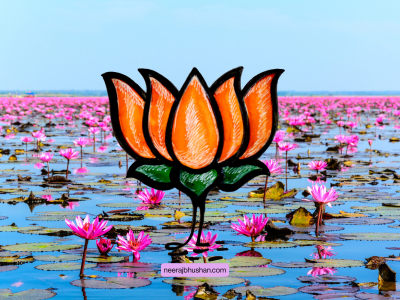
O’Brien argues the party blurs India’s 1950 national icon (BJP formed 1980, symbol allotted 1989) with its emblem, turning ancient purity into deceptive appropriation, amid Congress accusations of eroding secular India.
Brand Modi threatening to eclipse BJP symbol, the lotus
A 2013 Economic Times headline warned, “Brand Modi threatening to eclipse BJP symbol, the lotus,” highlighting how the party boosted the lotus in Bihar and Uttar Pradesh rally posters with slogans like “Narendra Modi Kamal Nishaan, Maang Raha Hai Hindustan” (Narendra Modi, lotus symbol is what the country wants).
The publication quoted BJP leader Shahnawaz Hussain emphasizing unity: “Modi and the lotus are not seen in different light. Earlier, the slogan was Atal, Advani Kamal nishaan… The Modi nectar is being offered in a lotus,” revealing branding risks where leader charisma overshadows the symbol itself.
This deliberate fusion of Modi’s persona with the lotus—as Shahnawaz Hussain’s ‘Modi nectar in a lotus’ metaphor suggests—exemplifies poor branding by BJP, allowing a single leader’s cult-like appeal to eclipse both the party identity and its symbol.
What was meant to symbolize collective purity and resilience—rising unsullied from mud—has been reduced to a personality-driven prop, vulnerable to party leader and Prime Minister Narendra Modi’s daily criticisms in Parliament and streets over Pulwama echoes, Pahalgam attacks, lopsided US trade deals, tariff pressures from Trump, and perceived neutrality in the ongoing Israel-Iran-US war.
Earlier slogans tied it to Atal Bihari Vajpayee and L.K. Advani before their fade; now, with Modi’s image battered by these flashpoints, the strategy risks rendering the lotus forgettable once the ‘nectar’ figure wanes, diluting a timeless national icon into transient hype.
The flower once symbolised purity of thought. Now, it stands for the BJP’s muddy politics. – Derek O’Brien, Member of Parliament from Bengal and Trinamool Congress Parliamentary Party Leader (Rajya Sabha)
BJP’s lotus evolution amid symbols shaping politics
India’s everyday symbols—like lotuses, bicycles, or animals—give clear identities to over 1,200 political parties, helping voters spot choices on ballot; these icons stay vital for instant recall.
The BJP shifted from its 1951 predecessor Bharatiya Jan Sangh’s oil lamp—linked to Hindu temple rituals—to the 1980 orange lotus, tying into deities, ascetics, Rashtriya Swayamsevak Sangh RSS orange flags, and India’s national flower.

BJP even pushed the lotus onto government papers – 2019 passports, 2023 G20 logos, and 2026 BRICS summit logo, blending national pride with party power.
Symbol on ration bags, narcissism and PR
On occasions, the BJP’s decision to put the lotus symbol on ration bags had met with criticism, with many redditors questioning the appropriateness of using a party symbol on government initiatives. “Isn’t free ration a government initiative? How can they put the logo of a political party on the bags?” Some redditors also viewed this as a narcissistic move by Narendra Modi and the BJP to claim credit for public welfare schemes.
Today, BJP’s lotus—far from embodying peace—appears divisive by design, its serene petals twisted into a badge of confrontation. Why taint this flower? Under Narendra Modi’s prime ministership, where he brands himself not just as PM but as the singular face of BJP, the party’s communication hyper-centralizes around his image, voice, and narrative—ministers toil in the shadows, their visibility tightly reined to keep the spotlight fixed atop. The lotus, once meant to rise pure above the mud, now stands eclipsed by this cult of personality.
A look at BJP’s hoardings and banners makes one feel that they are overcrowded, even when glorifying just one man over the party or its workers—making a beautiful lotus flower seem ‘crushed’ amid political slogans, leaders’ photos, and flashy saffron-green hues. This bad branding erases the flower’s natural elegance, which nature perfected while politics corrupted it. BJP masterfully shows how to politicize beauty, but at the cost of the lotus’s innate purity.
 Neeraj Bhushan